Wednesday, 17 March 2010

March Story - My Grandfather's Mysterious Visitors


I haven't been writing much lately. Not without a reason. Anyway, now that we stepped in March a story comes to my mind about another March, in another age, another country, another era. A little long, but definitely a true story. (Originally it was published on another website) Enjoy!

My Grandfather’s Mysterious Visitors

Who were they and why did they come?
I was about to write a winter story with lots of snow and even more ice when the message came: our editor-in-chief would like some essay on art. OK, I will try. But it is so hard to get rid of this winter, not only the topic of my would-be story (postponed till...), but also of the real one outside. March began with an abundant snowfall. That Friday afternoon I stumbled in knee-deep fresh snow on my two miles long way home from the place where the bus-driver dropped me off saying he simply couldn’t drive any further across this all-white hilly landscape. Two weeks later the waking spring still clenches its teeth and freely allows the wildest winds to ravage all over the villages and fields. The thick overcoats and completely windproof, waterproof jackets are still on us as the days grow longer and the nights become shorter.
It was a similar enduring hopelessness that enveloped us about twenty years ago, too. When will it end finally? And how? Will it end at all? These were the questions we silently asked ourselves day after day back in the communist era in Transylvania. But now, at least I know what I didn’t know at that time: every winter ends. It is a law that cannot be overruled or changed. Not even by the harshest, coarsest, rudest dictators. Neither by their armies, security apparatus, whistle-blowers, squeakers and bootlickers... Every winter ends one day, even the intellects’ and souls’ darkest frozen encagement - time...
Many questions of mine have been answered since those black days in Romania. Except the ones I asked on that winter day: who were those three and how did they come? I am afraid I will never get to know this. If my grandfather was still alive, I could ask him. But chances are high that he wouldn’t know it either. My grandfather was a man of lands, of grains and fields and forests and horses, he hadn’t read too many books until he grew too old to make hay.
He knew however more things than I could find in the books available in our mother tongue at that time. He was already an adolescent when the First World War broke out. Seventy years later, after a mug of beer he would still remember some of the songs sung in another age, in another country, yet in the same village. He grew into a man and he grew old in the same town, but around him the borders changed two times, so he changed passport and nationality, but not mother tongue, neither conscience nor religion. He knew every tree in the forest, every road around the town. He knew every river and brook, every forest pathway. He showed me the places where battles were fought, today’s potato fields watered once upon a time with our forefathers’ blood when Tatars invaded and scorched up our villages, when my ancestors refused the Habsburg rule, when they boldly went against the Austrian-invited allies from the Russian tsar’s army... when they lost all they could lose: their horses, cattle, sons and freedom.
My grandfather remembered the times BEFORE, before the big red revolution sequestrated his hardly earned properties, before his forests became the state-owned hunting grounds of the dictator and the bosom-friends of the latter one, before the “Comrades” forbade our language, before artists emigrated because they no longer could speak up, before food and fuel was rationalised to monthly portions distributed after night-long queues in front of the almost empty shops...
And he spoke to me. That was the root of all problems. He told me the truth. Thus he made me dangerous. By telling me, who he and my other forefathers were, he told me also who I was. That made very clear to me, who and what I was NOT. It was good and also perilous to know this at a time our dictator decided to eradicate 3000 Transylvanian villages for they were useless, obsolete and above all, proved a past that should be erased from history books. By God’s Grace this project could never be realised, but for some years the sword of Damocles kept hanging above our heads.
But long before that, when I was really still a child, we had that long and heavy winter. Towards the end of it, it still looked as if it had just started. In those days, cars were not allowed to circulate at all between November and March, for there was no gasoline. For us kids, this annoyance of our parents meant rather an unbothered roaming in neck-deep snow on the roads themselves after each abundant night-long snowfall. In a March or late February morning like this I ventured on the long and really arduous road to school. One kilometre of stumbling and raising my feet high all the time, covering the last section with totally wet boots and socks. Before leaving I asked my granddad to make me a snowman by the time I got back home. Apart from asking him once to buy me a toy – a painted bird that one could wind up like a clock and that would move around then – I don’t remember asking him anything ever.
I didn’t ask, because although we were sharing the same family house with my father’s parents, my mother was terribly upset with my paternal grandparents. My ever-open compassion-hearted mother, who would always send much-treasured food and delicacies to my poorer schoolmates or to needy neighbours, was very unforgiving whenever it came to her father-in-law. The reason of her staunch, inveterate and unceasing reproachful attitude was that my grandfather had had a hidden amount of money, and when the time came in 1977 he had given it away for a good cause forgetting to allocate a single penny to my parents. Ten thousand Romanian “Lei”-s were a significant sum in the nineteen seventies, more than a yearly salary of an average state-employed accountant like my mother. My parents didn’t have a home of their own. My mother’s parents gave everything they had to my mum, this is how my parents could buy a car. My paternal grandparents gave nothing, but at least they allowed my parents to have two rooms in their house. My mum would have loved to move away from there and live her own life and the mentioned money would have helped my young parents considerably. However, fate compelled my mother to sacrifice her dream of independence. The entire amount went away in an unexpected manner and thus my grandfather bought himself a place fifteen years later on the wall of my room in Budapest. He was the only family member of mine who managed to secure himself (or rather for his photo) a fix spot on a wall decorated by pictures of lotuses, snow-capped mountains, cosmic gods and famous rock climbers. Until the day I moved away from Budapest and stashed all my things in boxes he was hanging there on a framed black and white picture, on horse-back, proud, straight-backed, smiling, as a young father of two small children looking into a brighter future. Little had he known then on September 13, 1940 about what was yet to come. With a radiant face he looked as if he had thought, that yet there was a shortcut to the future.
How did he manage to gain my appreciation? In March 1977 a severe earthquake left the country in rubble. The capital, Bucharest was the most affected, but our town wasn’t spared either. The reconstruction lasted for years. Day after day I would be seeing the ruins of an already run-down fortress and the collapsed dome of our community church, the focal point of the lives of my fellows, the ethnic minority Hungarians of Transylvania. This church was built in the times of the Renaissance, at a place of a yet earlier smaller chapel. The first mention of the settlement dated back to 1321 A.D. and since those early days, whenever an enemy approached the place it was behind the walls of this small fortress that the local population, above all women and children could find shelter. Inside the walls the white church was first a Catholic church and when the waves of Protestantism invaded Transylvania, it was converted for ever. Its gothic shape, pure, ascetically plain white walls are my first memories of talking to God and also, of learning the history of man’s quest for a religion closer to God. These memories include also a hidden side-wall relief work representing the head of some big-eyed humanlike-being with Latin inscriptions underneath, some text from the fifteenth century of which at that time I only understood one single word “Daczo”, a still occurring Hungarian surname, probably that of a noble person or some leader of those bygone times.
After that dream- and wall-shaking, howling night in March 1977 only heaps of broken stones cried into the wind. Obviously, there was no money to start it all over again. The communist state would definitely not afford to sponsor the reconstruction of a minority, state-alien, irredentist, separatist, what worse, RELIGIOUS community building in the middle of the most feared Hungarian enclave of Romania. Out of question. It was German and Dutch volunteers and village communities that came with their big hearts and donations to enable the local priest and my irredentist, grandfather to buy and mix cement and to lay stone upon stone. Over seventy years old, my regime-fiend grandfather would put up his helmet day after day and go along with other volunteers to build the fortress and church back. In addition to that, he dug out that secret money and donated it in its totality for the reconstruction costs.
More than twenty years later, each time I visit my hometown and light-heartedly spend probably much more money there than those long-inflated ten thousand Leis, I walk home over the hill and I see the fortress, the tower of the church and the graveyard nearby. And I know that the earthly rests of my grandfather have a calm, unharassed sleep there. Regardless of my poor mum’s sacrificed freedom, he did the right thing. The church-tower is still standing erect there and can be seen from far.
So, it was this grandfather of mine to whom I said that winter morning: “Please, build a snowman for me by the afternoon.” I thought, I could ask him this favour, after all he had both time and snow beyond measure. Off I went along the almost tunnel-looking pathway to school and then to a school-theatre rehearsal. I reached home sometimes in the late afternoon, but still in daylight, since it was March already. The moment one enters our yard-gate one has an encompassing view of our entire yard, the two flower-gardens on its two sides, the backyard with hens and our dog as well as the barn at the end of it. So, basically I could see in the first second whether my snowman was there or not.
Well, it wasn’t there. What I saw made me run closer. Instead of a snowman, consisting of a huge snowball upon which there would be another, somewhat smaller snowball topped by a yet smaller snowball decorated with coal eyes and carrot nose, as one can expect from any decent snowman, I found there three statues. Aristotle, Socrates and Plato. Or Demosthenes, Cicero and Seneca. Or they could have been Marcus Aurelius, Julius Caesar and Octavian, or Martin Luther, Jean Calvin and Zwingli Ulrich, or why not, Michelangelo, Leonardo da Vinci and Rafael? Maybe Transylvania’s great governors from the hoary past, Gabor Bethlen, Istvan Bocskai and Ferenc Rakoczi? Or Goethe, Schiller and Rilke, perhaps George Mallory, Edmund Hillary and Tenzing Norgay, mayhap even Robert Frost, Norman Mailer and Allen Ginsberg... whoever. But definitely not some ordinary people. Three men, three busts on completely smoothed surface, perfect flat pedestals, three noble visages, far-penetrating eyes, bold cheekbones dashing against an unknown medium, all three of them looking into the same direction as they were lining up one next to another.
Who were they and how did they come? What message did they bring along for the ephemeral time between a heavy snowfall and the first spring sunbites? They were there mute, nobly raising their heads, not searching my regard, but rather looking somewhere far behind and above my head, and my grandfather next to them, just finishing with the last touches of his smoothing board. He had been working on my snowmen, his statues since I left in the morning. He used no carrot, no coal, no coloured material, only snow, water and smoothing or plastering tools. He wiped his front and with a smile inaugurated and gave over his artwork to me. Then he went into the house for he had cold. I was staring at the three visitors flabbergasted. Me, the ten year old proud owner of three white Carrara marble statues in the backyard standing with my feet growing roots into the snow beneath...
Then I had to go inside too, the dusk came with chillier breezes. I don’t remember much of that evening. One thing I find still strange though. Although my grandfather had never ever even drawn a sketch, neither my father, nor my mother seemed to be surprised at all, they left the wonder unmarked. Just as if it were so normal that we have three busts of three exceptional fellows in our backyard. Just as if my grandfather was a Rodin in disguise. Well, he wasn’t. He was a man of truth, of lands and forests, of arable fields and hard work, a man of horses and bicycles and also of a good beer sometimes. A man of stonesolid faith. A servant of the church, an expert of grains and herbs and cows... But he was definitely not an artist.
Just two days after that deep snow session my wonderful statues were reduced to small forsaken stubs soaking in icy water. I am the only one to know that on a late winter afternoon Aristotle, Socrates and Plato paid a voluntary visit to my grandfather, or were summoned by him there for my sake. Of course, they could have been Marcus Aurelius, Julius Caesar and Octavian, or Martin Luther, Jean Calvin and Zwingli Ulrich, or why not, Michelangelo, Leonardo da Vinci and Rafael as well. I don’t remember their faces well enough to compare them now to illustrations representing famous people of the past. But I do remember the smoothness and white nobleness of their faces. They definitely were there, maybe all simply to tell through their short-term snowstatue-carrier that every winter ends one day. That this is a decree which cannot be overruled by dictators and superpowers.
Oh yes, maybe that’s what they had to convey. Or, otherwise, who were they, and why did they come? Who will they visit next?

Sunday, 13 September 2009

Summer memories from August 2009 1. Yet


Yet

19 July 2009

This day is a YET day, as I am writhing in pain but I am not writing about pain.

After two days of driving in rain and strong winds, we arrived to our summer base camp at 2060 meters in Arolla.

Today we went down by foot to Les Hauderes. This is a 2-3 hrs journey, rather 3 for us, as I am having a bad lumbago or sciatic attack (maybe both, hm it really hurts both at the lower back and in the leg) and I had to stop frequently, plus we stopped each time we saw bouldering or rock climbing places (there was a nice clean rock with bolted routes at the hotel Aiguille de la Tsa, near the Camping, than we saw another bolted rock a little below Satarma, just behind a chapel, but in between the two there was again a Klettergarten with more difficult routes). Then we stopped each time Zoli discovered a rare flower or yet another species of butterflies. I was silently (well, sometimes moaning) suffering these cramps in muscles and tendons, and only being helpful when it came to linguistics: yes, papillon is masculin but hirondelle is feminine...

When we reached the village, we found the main square full of people, market stands, buffets with music, artisans displaying their works... book antiquaires etc. By then I really needed to sit down, Zoli really needed to eat (me too)... so finally we found a place to eat, right in front of a mobile children’s climbing wall. It was interesting to watch them, how they are temerary or how they fear and give up, how they don’t realise that they have feet too, that they could straighten their legs and would reach higher... How some of them keep trying and trying, how much energy they have...

Then we got bored of the townlike noise and went out in the woods again, slowly trudging up towards Ferpecle... It was interesting to find those brown wooden houses on every steep slope, where even cars cannot drive up, and sometimes to see that yes, they still go up to the least expected narrow pathways too. Alas, we never reached Ferpecle, as we had to descend in time for the last bus to Arolla... With this sciatica I wouldn’t have been able to walk up three hours long... By the time we got „home”, I hardly could walk. But at least I wasn’t angry at myself or at my fate that I had to spend my first day of holidays bed-ridden, down-trothed by sickness.

And the most important things: the weather was all day long splendid, sunny with a mild wind and some nice white clouds to make mountains even more beautiful. With all this pain it was still fantastic to walk on narrow pathways and feel the smell of herbs and flowers of an immense biodiversity, unaltered by planted species... I feel partly like a lame duck, unable to move to sit and to lie (what else is there, one can do with a renewed ache ?!) BUT partly like a recharged battery!

Zoli ran out, and almost climbed another slope up to 2800 m, just to take 30 more pictures of the same Mont Collon also before and when the sun goes down J.

Monday, 29 June 2009

Excerpts from my never-written Norway-Diary 3


3)

Why was I reluctant to follow him?

It was a really perfect day. Gift upon gift, the mere sight of nature’s extraordinary power in thundering waterfalls and the uncharted wilderness of large inhabited forest and bush-fields, the sub-arctic character of mountain landscapes, oh this was far more than what I ever expected of this Sunday.

Then the ferry across a fjord and the sight of another one from high... Then we were granted a gift journey to a mountain top. Under normal circumstances we work hard for such things, we walk and climb up and sweat and gasp while doing that. But now a sympathetic newly found friend bus-driver offers us a ride and we can do all of this 20 km mountaineering journey sitting in a vehicle. I guess, ten years ago I would have not admitted that this is how it happened. Now I am adult enough to be brave and tell: we didn’t climb Dalsnibba (1500 m) but were driven up there comfortably. Anyway, the view compensated us for any eventual remords of our mountaineer conscience.

The way back was just as spectacular as the way up had been. For the first time in years we went shopping souvenirs. And we actually had fun surfing through an entire huge shop in Geiranger. We touched and tried everything and bought things... And felt no dummies...

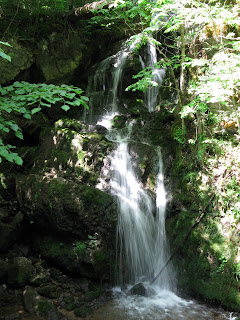
Then came the additional bonus of finding accommodation for that night! A beautiful little „hytte”, a hut, just as I had so much wanted to try out! A little red wooden house in the bushes, with white window frames, green grass on the top and a million dollar view from its terrace. The bonus of bonuses was an unchained waterfall in the proximity of our house, a real unleashed beast with sparkling wild white waters that stormed down in rays and – broken by the massive stones it fell on – returned for a brief moment to the air before relinquishing and being rushed away in form of white foam further down in the brook. I could have watched it for hours.

I found it hard to leave this sight for Zoli’s sake who discovered boulder routes nearby. He had climbed most of them, by the time I arrived to him. And then he disappeared just as I was still watching a perfectly constructed fireplace under the overhanging rock walls.

I knew instantly that he had found a path in the forest. Half of my heart wanted to follow him, the other half wanted to stay. I followed him on a narrow dark green pathway squeezed between green, plant-covered rocks dripping water and between the trees growing on top of another rock block.

We were on top of the bouldering block now. I was still halfway, he was already gone. It was almost midnight and I feared that the unexpected darkness would still come suddenly just when I am trying to find him in an unknown bush where who knows what imaginary and real trolls may wait for my companionship... I was actually more afraid of sprainting my ankle as I could no longer see well in the twilight of this narrow shadow-forest tightly stretched between two rocks. The path and its many stones seemed slippery and unstable at once – even if this was nothing compared to most of our mountain hikes. I knew he did not appreciate that I was reluctant and searched excuses of not going deeper into the forest, higher up on the slope. But to me this day has already given so much joy, so many surprises, so many gifts that I wanted to keep it that way, I was afraid not to ruin it with an ankle sprain in the twilight...

Then he finally appeared. We reached some water. Oh no, not some water, we actually found ourselves on top of the unleashed fierce waterfall. And the rays of the midnight sun penetrated the greenery now, framing our already fantastic view with tangible gold-diamond rays. Oh, good that I followed him... We were now in the middle of a guilded picture with translucent lights and cold watersteam and lush greenery...

My never ending day of luck and beauty – one in ten years – continued with a serene night-watching out in front of the house. Sipping milk and sitting, imagining how finally the grey shades overcome the facing mountains – and then I opened my eyes under the sun-glasses and that threatening night was still not there, the forests dreamed their lucid silver midsummer-night dreams and silently sang along the ceaseless roam of cascading waters.


Excerpts from my never-written Norway-Diary 2


2)

Perpetuated afternoons

It is almost midnight. Then midnight. Then 1 a.m. The sky is still in fire, sunrays beat up wast self-building clouds until they shed red foam to the shoulders of distant mountains. We keep looking. Then Zoli goes on reading, obviously without any lamp or artificial light. I keep peeping towards the uncurtained window. The spectacular drama goes on up there on the other shore of the fjord, and far far away on this side, more to the west. Also more to the east. And more to the south... Sunrays paint mountain peaks... just be a climber and watch this, you heart will scream of rapture.

However, Zoli gave it up after a while. He goes to bed desperately trying to find darkness, oh, just anything that would cover his eyes enough. Desperately trying to usher me to bed, as he knows that I will have a hard timewaking up in the morning.

No, I don’t want to sleep now, tonight of all nights. I slept between 1 a.m. to 4 a.m. yesterday and woke up at a triumphant, brilliant sunlight out there. The day before yesterday also. Tonight I am not going to let the mystery remain unsolved: what happens to the sky in the REALLY late night or the VERY early dawn? I need to know that and I am going to find that out now. I watch and daydream with open eyes in this never-ending afternoon that will eventually wake up itself as a new day’s morning. I don’t grow sleepy but my eyes slowly become very tired. I am on the verge of giving up. Not the red and orange light and cloud scenery outside – that goes on, the mixed colours softly pour down on the slopes of the other shore...

Finally an idea comes up. We have two watches, each of them having two alarm functions. I set the first watch to alarm at 1.30 a.m. and at 2 a.m. The second one will wake me up at 3 a.m. and at 4 a.m. After 4 a.m. I have already seen how it is: it is like like midday in Luxembourg. Thus I have myself woken up at every hour – what a nightwatching J To see what happens, to see if there is darkness for at least a half an hour.

Well, I woke up at each alarm, at each hour and yet – although we were still far from the Arctic Circle – the dark night somehow never came. The same light-grey and reddish twilight was there all the time. It was never darker than an average cloudy-rainy autumn afternoon in Luxembourg. But it was definitely a happier shade, and a more heart-opening mood of the sky. Of course, Norway pays a hard price for this when winter sets in. But my surprised child mentality could not be more content with this natural white night experienced for the first time.

Excerpts from my never-written Norway-Diary


1) The endless hours of beauty

I change my mind often, but to the question: what was the best thing in Norway, I would always give the same answer. The best of all was that certainty of beauty.
The fact that I woke up every morning with a sure feeling: we see something beautiful again, today as well. Just think of it:how often can you be sure every morning that something good is definitely going to happen to you today? Especially if you live in a place like Bettembourg...

Well, somehow with my hard-earned money I earned from destiny these eight days when beauty and smoothless encounters with nature were granted and guaranteed. Thank you Norway, from all my heart, ’thank you’, all the nice and helpful people we met on our way, thanks for the civilised and clean infrastructures that made our journey comfortable for us, two backpackers who never want to grow old.

Wednesday, 24 June 2009

24 hours and 36 minutes

In case you were wondering how much time one needs to travel by public transport from the coast of the Norwegian Arctic Sea (more specifically from the top of Fjellstua hill) all the way down to the Luxembourgish-French border, the answer is here:
24 hours and 36 minutes.

Yesterday evening Zoli and I rushed down this little rockhill overlooking a fabulous sea-coast-island-fjord-town landscape, we picked up our rucksacks from the youth hostel (Vandrerhjem) of Aalesund and with two (four :-) fully packed rucksacks (both of us had a big one and a smaller one for the daily trips) we trudged to the Nor-Way bus station on the coast. Our bus left at 21.00 hours exactly, and it covered the best parts of Middle and South Norway.

For us it was partly a recapitulation of what we had visited earlier this and last week: the coast of Aandalsnes, the enormous Romsdalshorn wall, the waterfalls breaking their chains and freely rushing into the Rauma (river), the valley of Dombaas, Lillehammer, deers crossig our route in the white night, the fjord-shore fires announcing this years Midsummernight... and a very well timed, "second-by-second precision to the schedule" arrival to a sunny, hot Oslo... a place we had come to like the week before.

The rest is just another story of journey, train to Sandefjord, aircraft to Hahn in Germany, bus to Luxembourg, train to Bettembourg. We are back, tired, with heads strangely stuffed, after all we hadn't had much sleep...
Just now Zoli is telling me what feels strangely for him: the fact it is getting DARK. Oh yes, for 8-9 days we didn't have nights. Except for three hours of sobre twilight in Oslo, more to the north we had really no night. At most one or two grey hours but even those were filled with life, birds still hunting, me still reading on the balcony of the hytte without any electricity or candle needed...
It was amazing not to have darkness at all...

Monday, 8 June 2009

Green


Sometimes it is good to stay down. Closer to the everyday ground. OK, I am a little bit talking like LaFontaine's fox about the sour grapes, considering that recently I have been rather unsuccessful in mountaineering. But this latest trip wasn't even meant to reach somewhere really high. We just wanted to climb and exist... with no particular summit-like target :-)

And here we go, we found Meiringen (in Switzerland). It is supposed to be a Mecca for rock climbers. Well, the rock routes - they weren't easy for us to find. We had no maps. There were many, too many paths up there on the hillside, in the forest and none of them had any specific direction indication, except for "Wanderweg" :-)

This is how our day turned to be a little frustrating for him, he kept sighing that we didn't have a topo. That we should never leave without proper topos (maps). Well, true, but I hadn't been able to find any.

On the other hand I was just so happy trudging up the hills after him, much slower, yet keeping a steady rhythm in the exceptionally hot May Saturday afternoon... Finally out IN the forest!

Everything was so green. Leaves and trees, fields, the landscape was dominated by its freshness. Even next day, the river canyon we visited, the famous Aareschlucht wore overwhelmingly green shades, green water perpetually meandering along its own heavily carved narrow canyon-way, with green branches peeping in from the top of the rocks on both "shores" of the gorge.

All in all, it was a very inspiring green. A colour of hope and renascent life, that feeds you one last time before you, mountain climber set off again to steeper routes up into the White.

Sunday, 7 June 2009

strawberry temptation


the power of strawberries

Red when ripe, they are tiny Martian superbombs of taste... No, I am not talking about those artificial looking, unripened, half-green half-rosy, plastic-package strawberries you can buy in supermarkets (those are fruits of human impatience, hard fruits plucked well before time, because a contract with the huge commercial chain obliges producers to deliver in time - no matter what).

I am talking about REAL strawberries, the ones that may not have the size as described in an officially approved list (a directive or catalogue), but do have a thousand times more TASTE and colour. They bring with themselves the memories of earth, of a dark or dust-gray dappled grounds, dry or wet soils - so close to them once, until your eyes picked them and your hands plucked them... They bring you maybe memories of a childhood where you could run wild and devour childhandfuls of fruits from your grandparents' or -secretly- your neighbours' field. They bring a touch of temptation, too, just see your own wine-red lips and white teeth as you gently put them one by one in your mouth - the gesture both feels and looks so sensual, it hides an invitation to action and a sense of daring exposition.

Strawberries, oh, their ripening has always been a feast in my life. When they pushed up their little bright heads, it was time to stop learning for school, it was time to rush out to the garden. Their brilliant red fruits in a big bowl - this was my mother's simplest but best gift I claim every year even if I am thousand miles away. Except for this year...

This year was special. Specially bad - many challenges at work, in family, at my own time-management. Failures in things everybody else so easily absolves... Or just bad luck? Like in many other people's lives. To the point that I am not able to pay my strawberry pilgrimage to my parents' place.

And then came friends. They grabbed me out from my stupor and figuratively tossed me in a car to venture out to Germany to a "pluck yourself" farm. And there I was. Finally some real ground below my feet (still unused to the ever changing rhythm of earth and moving walkways)! Finally some real colour, real movement as I bend myself to reach ruby-like treasures. The smell of sand and earth, the smell of dust and bright-red fruity, hearty perfume puts me back to the trail again.

Here I am, still not giving up - still beating this path I created for myself after a Mondfinsternis, a full moon eclipse and a major car crash threw me out from an illusionary cradle and seemingly safe haven. I am out in the savannas, feeling the lion cub in me and learning to roar. Roaming on vast strawberry fields and turnig swiftly in our orange-white-red coloured kitchen while cooking strawberry jam...

I am back to life again, back to fight depression, back to strive to make this life enjoyable - to relearn and discover the little joys of weekdays - thanks to my friends and thanks to beautiful brilliant perfumed dark-red strawberries.